Written by Cyprian Aarons, founder and principal engineer at Topiax.
Reviewed August 4, 2026 by Cyprian Aarons
About the authorAgent reliability engineering is the practice of designing, evaluating, and operating AI agents and RAG workflows so they fail within known limits - with traces, guardrails, human approval, and a release decision. It is closer to production engineering and risk management than to prompt novelty or model chasing.
Topiax uses this frame for UK and US B2B teams that already have a live or near-live workflow and need evidence it can behave under real use.
Why the category exists
Demos optimise for fluency and a happy path. Production optimises for:
- Wrong retrieval and stale knowledge
- Tool errors and partial side effects
- State loss across steps
- Permission and tenancy mistakes
- Cost and loop blow-ups
- Silent “success” that still did the wrong thing
Gartner has highlighted escalating cost, unclear value, and inadequate risk controls as drivers that will cancel many agentic projects. Reliability engineering is the response: make the system inspectable and controllable, not merely impressive.
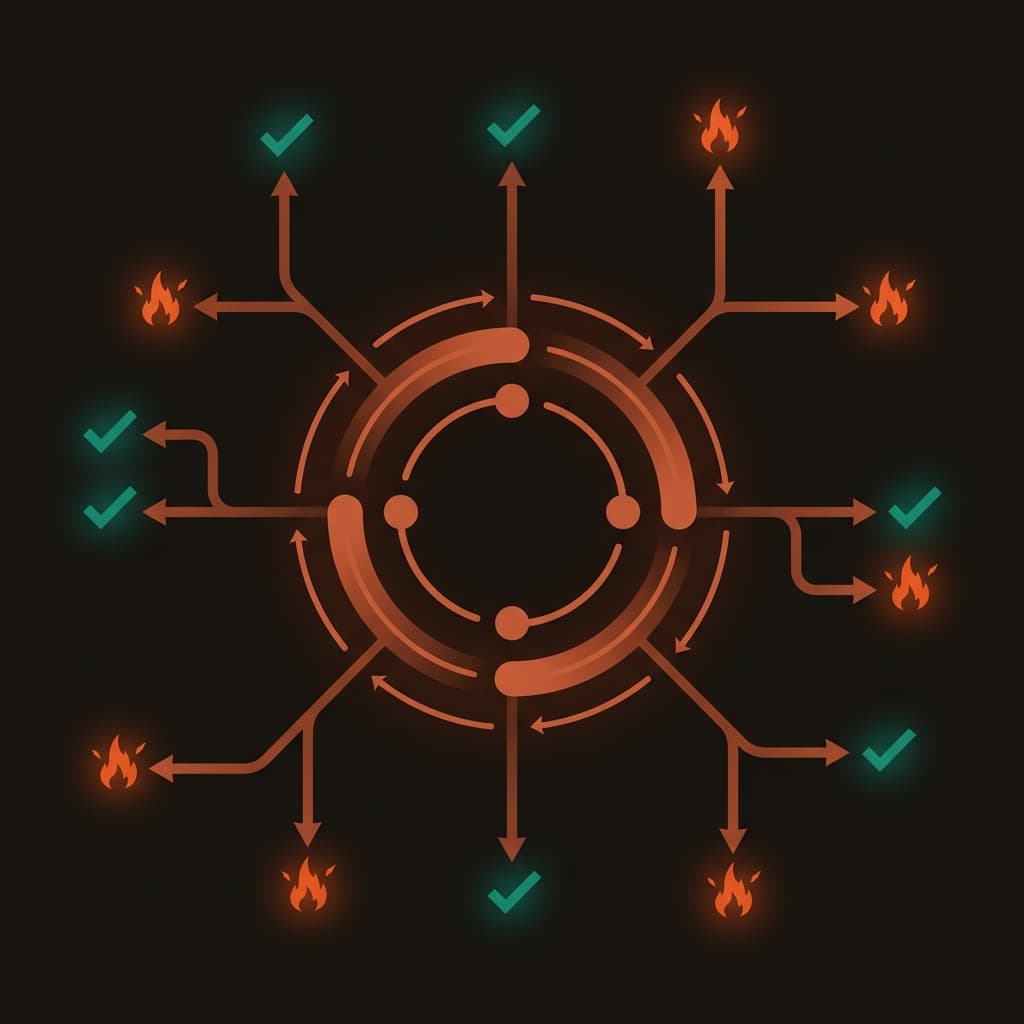
The operating model (five loops)
1. Map the work and the cost of failure
Name the user, the systems of record, the actions the agent can take, and the business cost of each failure mode. Without this map, evaluation is random.
2. Evaluate representative behaviour
Build cases from edge paths and production traces. Score path quality as well as final answers. Detail: agent and RAG evaluation.
3. Constrain actions (guardrails)
Permissions, validation, fallbacks, approvals, stop conditions. Detail: guardrail design.
4. Observe production
Traces and metrics that explain a single failed run and surface systemic patterns. Detail: observability vs evaluation.
5. Gate release and learn
No silent prompt/model/index changes. Must-pass cases, a go / no-go owner, and new failures promoted into the suite.
What agent reliability engineering is not
- Not a promise of zero hallucinations
- Not a replacement for product strategy or data quality programmes
- Not a full security pen test or legal compliance certification
- Not “hire someone to vibe-tune prompts until the board is calm”
Those may matter, but they are different products.
Who needs it
Strong fit:
- Seed to Series B or mid-market teams with an agent/RAG path that affects customers, revenue, or regulated work
- A named owner who can approve scope and access traces
- A release, incident, or customer escalation creating urgency
Weak fit:
- No workflow yet - only ideation
- No access to evidence
- Desire for guaranteed accuracy marketing claims
How Topiax packages the work
| Need | Offer |
|---|---|
| Scored gap profile | Free reliability audit / scorecard |
| Harden one existing workflow | $4,500 Reliability Guardrails sprint |
| Build the integration first | Custom AI Integration |
| Pre-launch app readiness | Ship with Confidence Review |
Cost and comparison detail: What AI reliability consulting should cost · Topiax vs freelancer vs doing nothing.
A one-week internal start (no vendor required)
- Pick one workflow with a real failure cost.
- Write the top five failure modes.
- Collect 20 cases (including must-escalate).
- Turn on end-to-end tracing for that workflow.
- Block one class of irreversible action behind approval.
- Assign a release owner and a kill switch.
If you cannot complete those six steps, you are not ready for broader automation - regardless of model quality.
Practical next step
If the demo worked and production is now the problem, start with why agents fail after demos, then run the free audit or book a fit call when the workflow, owner, and failure cost are clear.
Every Tuesday
Get the next production AI lesson in your inbox.
Production Agent Dispatch turns each week's field note into one failure pattern, one practical control, and one next move. Four minutes or less.
Need this in your workflow?